Humboldt Waterkeeper
  • About Us
    • Our Mission
    • Waterkeeper Alliance
  • Humboldt Bay
    • Geography
    • Wildlife
    • Bay Issues
    • Photo Gallery
  • Programs
    • Toxics Initiative
    • Water Quality
    • Bay Tours
    • Community Outreach
  • Get Involved
    • Report Pollution
    • Speak Out
    • Volunteer
    • Donate
    • Membership
    • Stay Informed
  • Contact Us
  • News
    • Latest
    • Press

Sea Level Rise

The Humboldt Bay area is experiencing the fastest rate of relative sea level rise on the West Coast. That's because tectonic activity is causing the ground beneath the bay to sink at the same rate that the ocean is rising. According to the California Ocean Protection Council's 2024 Science & Policy Update, sea level in the Humboldt Bay area is expected to rise approximately 1.5-2 feet above 2000 levels by 2060 and 3.9-5.5 feet by 2100. 
The primary impacts from sea level rise are increases in flooding, erosion, and rising groundwater. Sea level rise will expand areas vulnerable to flooding during major storms, as well as in the rare but catastrophic event of a major tsunami. The term 100-year flood is used as a standard for planning, insurance, and environmental analysis. But these extreme storms are happening with increasing frequency, in part due to rising seas. Sea level rise will cause more frequent—and more damaging—floods to those already at risk and will increase the size of the coastal floodplain, placing new areas at risk to flooding. To view sea level rise scenarios for the Humboldt Bay area, visit NOAA's 2022 Sea Level Rise Viewer and go to the local scenario for the North Spit. 
NEW! Now you check out our interactive map of two sea level rise scenarios for the Humboldt Bay Area! Featured are scenarios showing 1- and 2-meters above Year 2000 water levels. For many years, these have been static maps with no simple way for the public to examine points of interest. Now, people wondering if their neighborhood is at risk can zoom in on locations and see street names, etc. 


Two Bay Area counties sue 37 fossil fuel companies over sea-rise

Details
Richard Halstead, San Jose Mercury News
In the News
19 July 2017
Created: 19 July 2017

7/17/17


Two Bay Area counties sued 37 oil, gas and coal companies Monday asserting the companies knew their fossil fuel products would cause sea level rise and coastal flooding but failed to reduce their greenhouse gas pollution.

The lawsuit was part of a coordinated litigation attack by Marin, San Mateo County and the city of Imperial Beach.


The lawsuit, filed in Marin County Superior Court, alleges that “major corporate members of the fossil fuel industry, have known for nearly a half century that unrestricted production and use of their fossil fuel products create greenhouse gas pollution that warms the planet and changes our climate.”


Read More

Preparing for Sea Level Rise in the Humboldt Bay Area

Details
Jennifer Kalt for EcoNews
In the News
08 March 2017
Created: 08 March 2017

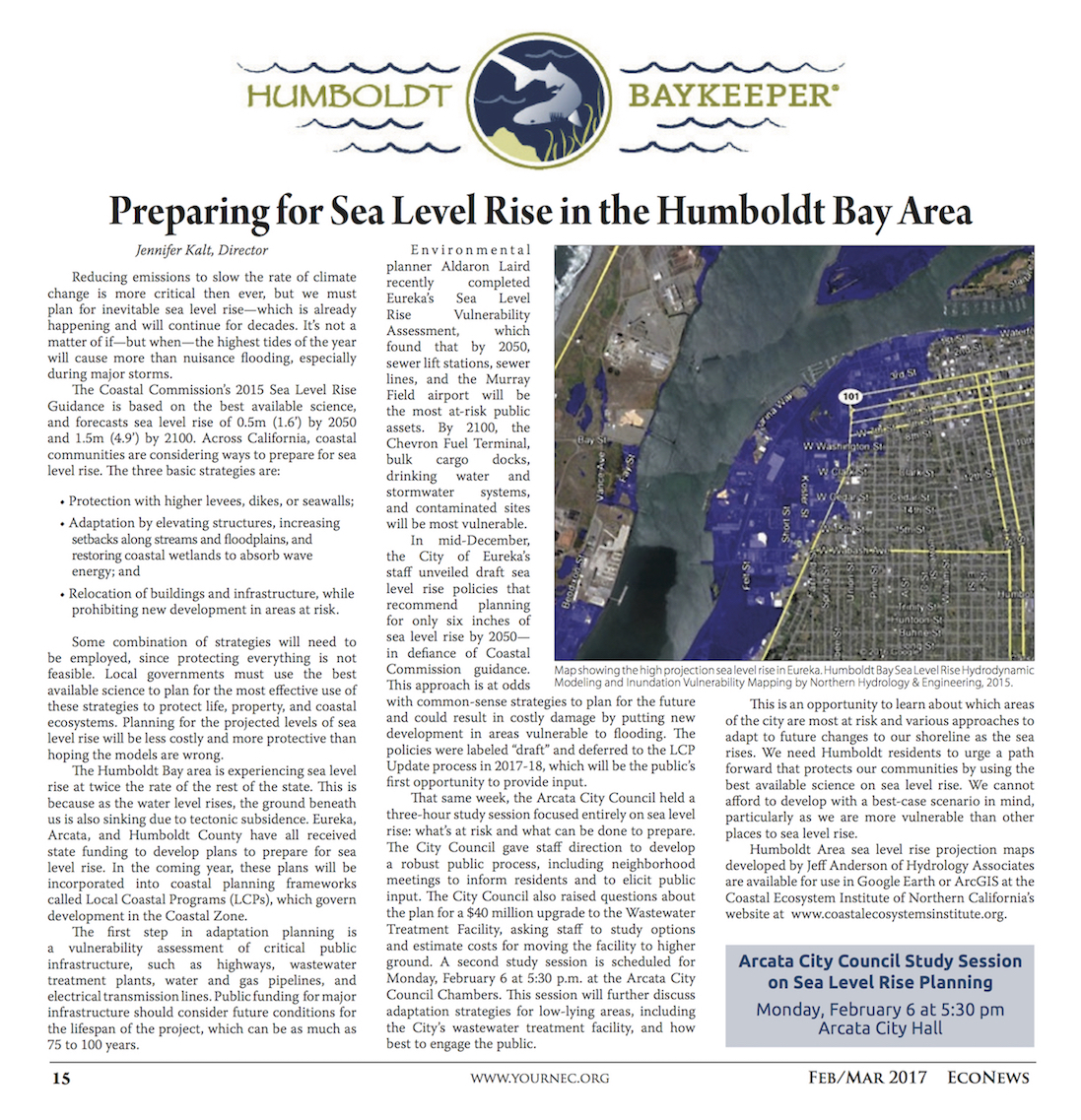
Arcata and Eureka are beginning to prepare for sea level rise, and there will be opportunities for the public to weigh in throughout 2017. Reducing emissions to slow the rate of climate change is more critical then ever, but we must also plan for sea level rise, since the Humboldt Bay area is experiencing sea level rise at twice the rate of the rest of the state due to tectonic subsidence. 

Read more …

NOAA Sets New Sea Level Upper Limit To Over 8 Feet

Details
John Englander, http://www.johnenglander.net
In the News
06 February 2017
Created: 06 February 2017

1/30/17


Last week the National Oceanic and Atmospheric Administration “NOAA” issued a new 44-page report, “Global and Regional Sea Level Rise Scenarios for the United States.”  They have created a new projection line for as much as 8.2 feet (2.5 meters) by 2100, the red colored line shown above, based upon a comprehensive assessment of the latest science primarily focused on Greenland and Antarctica. Eight feet of higher sustained sea level will be catastrophic for almost every coastal community in the world.


What makes this so hard to accept is that we have never had this level of sea level rise in all of human civilization. The last time sea level was higher than present was 120,000 years ago. Then it reached about 25 feet higher than present (7-8 meters). Based on the current temperature levels, we will almost certainly reach that height. The question is how soon. That does depend on how aggressively we work to reduce the level of greenhouse gases – largely carbon dioxide. In all my talks and briefings, I try to leave two takeaways:


  1. To slow rising sea level and the other effects of climate change, we must reduce greenhouse gases as quickly as possible. However, regardless of the fact that we can slow the rise, we can not stop it in the coming decades. The ice melting and the sea rising have passed a “tipping point” and will continue for centuries.
  2. We must begin planning and adapting to higher sea level NOW! That would be the smart thing to do recognizing the new record flooding in coastal areas, as a result of more severe storms, record rainfall, and extreme high tides, all compounded by rising oceans.


A few places are beginning the process to look at how to adapt to higher sea level — in fact there are dozens of communities around the US and globally that are starting to take this huge challenge quite seriously. This new NOAA Report and the 8 foot red line should add urgency to begin the process and to think ahead — so that our investments in buildings and infrastructure are truly good investments, ones that will protect us today and be a good foundation for communities of the future.


Read Entire Article
Perils of Climate Change Could Swamp Coastal Real Estate

Details
Ian Urbina, New York Times
In the News
01 January 2017
Created: 01 January 2017

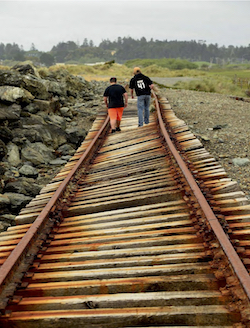
Homeowners are slowly growing wary of buying property in the areas most at risk, setting up a potential economic time bomb in an industry that is struggling to adapt.


11/24/16


MIAMI — Real estate agents looking to sell coastal properties usually focus on one thing: how close the home is to the water’s edge. But buyers are increasingly asking instead how far back it is from the waterline. How many feet above sea level? Is it fortified against storm surges? Does it have emergency power and sump pumps?


Rising sea levels are changing the way people think about waterfront real estate. Though demand remains strong and developers continue to build near the water in many coastal cities, homeowners across the nation are slowly growing wary of buying property in areas most vulnerable to the effects of climate change.


Read more …

‘Arcata is not going to be here’ – city to adapt, protect and retreat from sea level rise

Details
Kevin Hoover, Mad River Union
In the News
28 December 2016
Created: 28 December 2016

12/25/16


“By 2050, this will be normal,” said Aldaron Laird, standing near the top of an Arcata wastewater treatment pond levee as waves broke at his feet.


A small group had trekked out to the Rising Tides Bench during a nine-foot King Tide on Dec. 13 for a discussion of sea level rise, its imminence and consequences.


While the bay’s present borders can more or less withstand today’s King Tides – also known as perigean spring tides, which coincide with maximum gravitational pull by the moon and sun – that won’t be the case when they ride in on top of tomorrow’s raised sea levels. At that point, seawater would overtop current levees and inundate coastal areas, including homes, farms, businesses and critical public infrastructure.


The higher sea levels are not an “if,” they’re a “when.” What we don’t know is exactly when.

Read more …

More Articles …

  1. Eureka Plans to Flout Coastal Commission Recommendations on Sea Level Rise
  2. Humboldt Bay Sea Level Rise Inundation Mapping
  3. Obama Moves To Protect Against Flooding From Rising Sea Levels
  4. King Tides are back sans storms

In the News

King Tide Photo Initiative

  • Start
  • Prev
  • 6
  • 7
  • 8
  • 9
  • 10
  • 11
  • 12
  • 13
  • 14
  • 15
  • Next
  • End

Advanced Search

Current Projects

  • Mercury in Local Fish & Shellfish
  • Nordic Aquafarms
  • Offshore Wind Energy
  • Sea Level Rise
  • 101 Corridor
  • Billboards on the Bay
  • Dredging
  • Advocacy in Action
  • Our Supporters
Report A Spill
California Coastkeeper
Waterkeeper Alliance
Copyright © 2026 Humboldt Waterkeeper. All Rights Reserved.