Humboldt Waterkeeper
  • About Us
    • Our Mission
    • Waterkeeper Alliance
  • Humboldt Bay
    • Geography
    • Wildlife
    • Bay Issues
    • Photo Gallery
  • Programs
    • Toxics Initiative
    • Water Quality
    • Bay Tours
    • Community Outreach
  • Get Involved
    • Report Pollution
    • Speak Out
    • Volunteer
    • Donate
    • Membership
    • Stay Informed
  • Contact Us
  • News
    • Latest
    • Press

Sea Level Rise

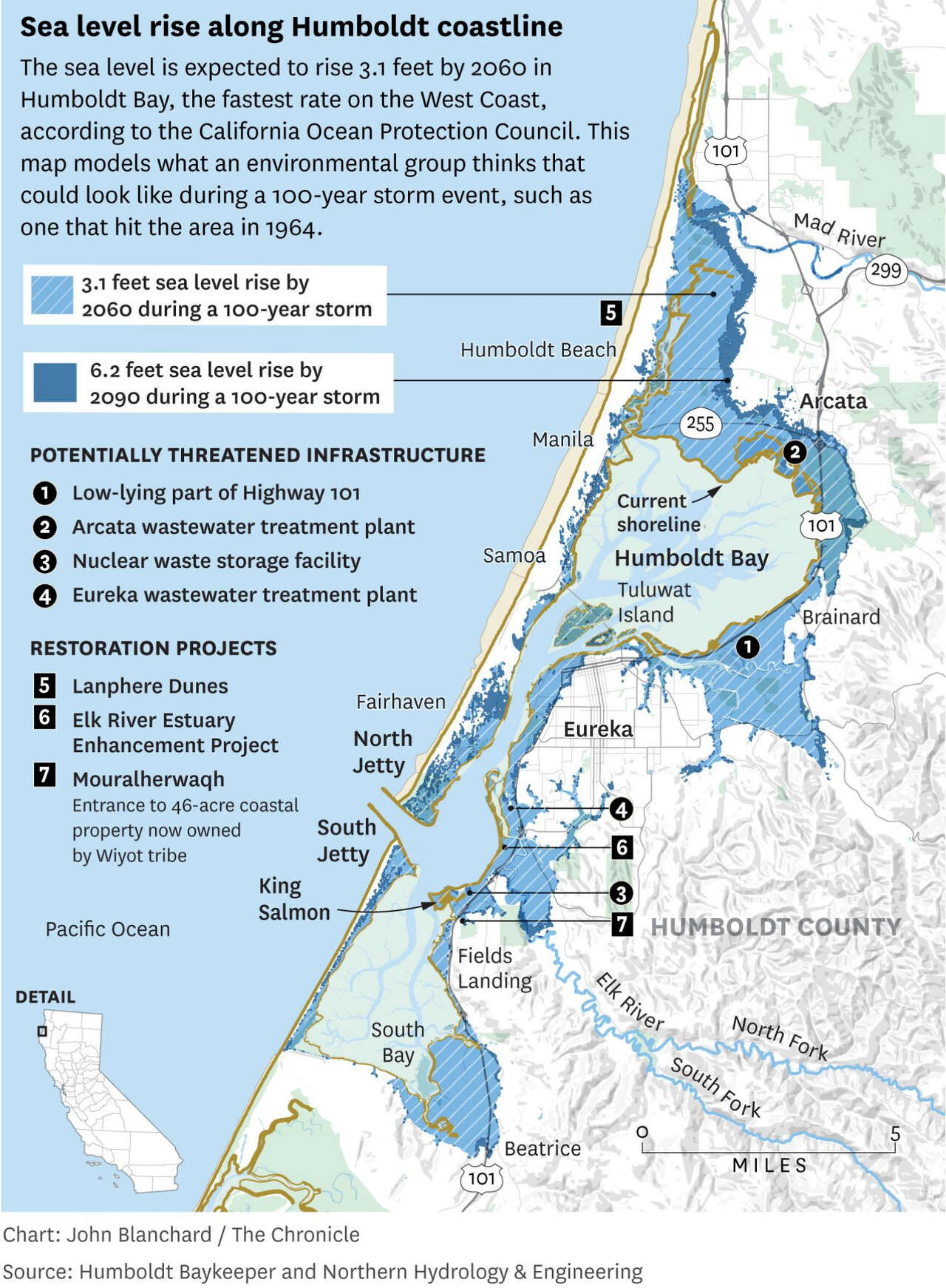
The Humboldt Bay area is experiencing the fastest rate of relative sea level rise on the West Coast. That's because tectonic activity is causing the ground beneath the bay to sink at the same rate that the ocean is rising. According to the California Ocean Protection Council's 2024 Science & Policy Update, sea level in the Humboldt Bay area is expected to rise approximately 1.5-2 feet above 2000 levels by 2060 and 3.9-5.5 feet by 2100. 
The primary impacts from sea level rise are increases in flooding, erosion, and rising groundwater. Sea level rise will expand areas vulnerable to flooding during major storms, as well as in the rare but catastrophic event of a major tsunami. The term 100-year flood is used as a standard for planning, insurance, and environmental analysis. But these extreme storms are happening with increasing frequency, in part due to rising seas. Sea level rise will cause more frequent—and more damaging—floods to those already at risk and will increase the size of the coastal floodplain, placing new areas at risk to flooding. To view sea level rise scenarios for the Humboldt Bay area, visit NOAA's 2022 Sea Level Rise Viewer and go to the local scenario for the North Spit. 
NEW! Now you check out our interactive map of two sea level rise scenarios for the Humboldt Bay Area! Featured are scenarios showing 1- and 2-meters above Year 2000 water levels. For many years, these have been static maps with no simple way for the public to examine points of interest. Now, people wondering if their neighborhood is at risk can zoom in on locations and see street names, etc. 


Humboldt County plans to use living shoreline to mitigate sea level rise between Brainard, Bracut

Details
Sonia Waraich, Eureka Times-Standard
Sea Level Rise
18 October 2022
Created: 18 October 2022
The county is planning on mitigating the risks of sea level rise along a particularly vulnerable stretch of Highway 101 between Eureka and Arcata by restoring salt marsh.
Restoring about 17 acres of salt marsh along a 1.25-mile stretch of Highway 101 between Brainard and Bracut would reduce the risk of flooding and the erosion of the shoreline for at least a century, Humboldt County Public Works Deputy Director Hank Seemann told the commissioners of the Humboldt Bay Harbor, Recreation and Conservation District on Thursday.
“If sea level rise continues to accelerate, there would be some point in the future where the salt marsh could get flooded out, but our study concluded it would likely have benefits for several decades,” Seemann said.
The Humboldt Bay Natural Shoreline Infrastructure Feasibility Study, which was completed in September, illustrated the most feasible designs and what the shoreline is expected to look like once the project is complete.
Read More

What sea level rise, tectonics mean for North Coast

Details
Lori Dengler, Eureka Times-Standard
Sea Level Rise
09 October 2022
Created: 09 October 2022
Sea level is rising more rapidly in the Humboldt Bay region than in any other place on the US West Coast. Cal Poly Humboldt’s Center for Sea Level Rise has been looking at the implications and last Monday, the San Francisco Chronicle gave us feature treatment.Sea level is rising more rapidly in the Humboldt Bay region than in any other place on the US West Coast. Cal Poly Humboldt’s Center for Sea Level Rise has been looking at the implications and last Monday, the San Francisco Chronicle gave us feature treatment.
Sea level rise became news in the 1970s. Studies were published and in 1988 the UN formed the Intergovernmental Panel on Climate Change was formed. Since 1993, satellite altimetry has provided a global picture of the rising oceans. The current estimate of average sea level rise is 3.4 millimeters (.13 inches) per year. There is no gray area here, it is a measured fact.
But the ocean isn’t a bathtub, and the rise is not uniform, rising more rapidly in some areas and dropping in others. How water level changes locally is a function of many variables. The three most important are thermal expansion, the supply of water, and deformation of the sea floor.
Water expands as it warms. A warmer ocean raises sea level with no additional water. Expansion rates are complex and depend on salinity, temperature, and pressure. There are seasonal changes and longer ones. Thermal expansion in strong El Niño years can raise the background tide levels by nearly a foot.
Read more …

This part of California has the fastest sea level rise on the West Coast. Here’s what’s at stake

Details
Țara Duggan, San Francisco Chronicle
Sea Level Rise
01 October 2022
Created: 01 October 2022
Anchored by the cities of Eureka and Arcata and known for its redwood forests, cannabis tourism and cool, misty beaches, Humboldt Bay also has an unwelcome distinction: It has the fastest rate of sea level rise on the West Coast.
Tectonic activity is causing the area around the bay roughly 300 miles north of San Francisco to sink, which gives it a rate of sea level rise that is about twice the state average. Compared to 2000, the sea in the area is expected to rise 1 foot by 2030, 2.3 feet by 2050 and 3.1 feet by 2060, according to California Ocean Protection Council.
Residential areas, wastewater treatment plants and a segment of Highway 101 that connects Eureka and Arcata are all at risk — especially when the frequent and intense storms associated with climate change trigger more flooding. There are even long-term worries about a nuclear waste storage facility on the bluffs. Yet the region also has become a test case for how to adapt to a problem that faces all of coastal California, including by restoring wetlands that were filled in for logging and farming in earlier eras.
“We say the bay is going to take back from us what we borrowed for the last hundred years or so,” said Jennifer Kalt, director of the nonprofit group Humboldt Baykeeper and a member of the Cal Poly Humboldt Sea Level Rise Institute.
Read More

500-Year Floods Coming to New York Every 24 Years, Study Says

Details
Phil McKenna, Inside Climate News
Sea Level Rise
18 December 2015
Created: 18 December 2015
New York City is vulnerable to rising seas and larger, more powerful storms that result in more frequent and intense flooding and what was once a 500-year flood prior to human-induced climate change now occurs on average once every 24 years. This is according to a study published in the Proceedings of the National Academy of Sciences.
“Flood heights are increasing and have increased since the pre-anthropogenic era, not only because of rising sea levels but also because of the impact that climate change is having on tropical cyclones,” said lead author Andra Reed of Penn State University.
Reed and colleagues made their conclusions based on climate models that simulated tropical storms and subsequent flooding for the region beginning in 850. They found that average flood height increased by more than 4 feet from 850 to 2005.
When Hurricane Sandy hit New York in 2012, it caused an estimated $50 billion in damage and destroyed at least 650,000 houses. Prior to 1800, such a flood could be expected to hit the city every 3,000 years. Today, a flood of that magnitude will occur on average every 130 years, Reed said. 
“Our planning is not designed to look forward,” said Melanie Gall, a University of South Carolina professor who studies disaster risk and emergency management. “When you look at flood insurance or how flood zones are mapped, it is always based on past events. It never looks at how storm surge will change in the future. There needs to be more proactive planning.”
Continuing development in New York and other coastal areas is also making the impact of such floods worse, similar to how water in a bathtub rises when displaced by a person entering the tub.
“The area that will be affected is larger because there is more development,” Gall said.
Read More

44 Feet: The de-facto nuclear waste site on the edge of Humboldt Bay and one group's efforts toward an atomic-ally correct future

Details
J.A. Savage, North Coast Journal
In the News
15 September 2022
Created: 15 September 2022
Forty-four feet isn't all that high. It's halfway up the tall side of the county courthouse. If you stacked Guy Fieri seven-and-a-half times on top of himself, his platinum blond hair would reach 44 feet high. Forty-four feet is also the height above today's sea level where 37 tons of radioactive waste from the former PG&E Humboldt Bay power plant is entombed in a concrete vault at the edge of the bay. A new coalition called, you guessed it, 44 Feet has brought together state agencies, federal and local political interests, scientists, a few folks with no titles at all and, to some extent, the nuclear plant's owner, PG&E. Like nanoplastics and deep-fried butter, most of us do not want to think about radioactive waste stored nearby, but 44 Feet is trying to plan for its future safety, even if that future is 100,000 years away.
PG&E's old nuclear power plant sat next to U.S. Highway 101 at King Salmon. It ran a brief and ignominiously leaky life from 1963 to 1976. Still, it produced high-level radioactive waste from the uranium fuel it used to create electricity. The radioactivity has cooled somewhat in the intervening years, but it will remain hot and toxic for more than 100,000 years.
Read More 

More Articles …

  1. The Sea Also Rises: Humboldt County Grand Jury Report on Sea Level Rise 
  2. It’s time to start planning for sea level rise, says Humboldt County grand jury
  3. Crucial Antarctic Glacier Likely to Collapse Much Earlier than Expected
  4. Racing the Rise: Caltrans and the daunting timeline for protecting 101 from the impacts of climate change

In the News

King Tide Photo Initiative

  • Start
  • Prev
  • 1
  • 2
  • 3
  • 4
  • 5
  • 6
  • 7
  • 8
  • 9
  • 10
  • Next
  • End

Advanced Search

Current Projects

  • Mercury in Local Fish & Shellfish
  • Nordic Aquafarms
  • Offshore Wind Energy
  • Sea Level Rise
  • 101 Corridor
  • Billboards on the Bay
  • Dredging
  • Advocacy in Action
  • Our Supporters
Report A Spill
California Coastkeeper
Waterkeeper Alliance
Copyright © 2026 Humboldt Waterkeeper. All Rights Reserved.