BRIEF OVERVIEW: In 2022, the Bureau of Ocean Energy Management (BOEM) awarded two lease areas 20-30 miles west of Humboldt Bay to offshore wind developers. BOEM’s environmental review process for offshore wind development is separated into two analyses. First is environmental impact assessment of the impacts of the studies that need to be done, such as the use of buoys, radar, and sonar. Next, after studies of the lease areas are complete, Environmental Impact Statements will analyze impacts from construction and operation of the wind turbines. These processes will be done separately for the two lease areas.Also in 2022, the California Coastal Commission reviewed plans for studying marine life in the proposed Humboldt Wind Energy Area, 21 miles west of Humboldt Bay. We submitted these comments and these comments. The plans for studies were approved with seven conditions, including a vessel speed limit of 10 knots (11.5 mph) to decrease the likelihood of collisions with whales and other marine mammals.In 2023, the Humboldt Bay Harbor, Recreation, and Conservation District issued a Notice of Preparation for the proposed Heavy Lift Terminal in Samoa. We submitted these comments on the potential impacts that must be addressed in the Draft EIR, which is being developed. For more info, check out the website we developed with colleagues at EPIC and CORE Hub: FAQs on Offshore Wind Energy.LATEST NEWS on Offshore Wind Energy:
Workshopping the new Humboldt Bay Area Plan, the county’s Planning Commission is highlighting the importance of offshore wind energy but leaving industrial port activity open for other uses.The extent of restricting heavy lift marine terminals – which will be necessary for wind energy but could also be used for other industrial purposes – was weighed as the commission held two workshops on the plan.Consensus on how to address heavy lift marine terminal use was reached at the second workshop, on Aug. 6, after lengthy discussion.Enthusiasm for wind energy has been tempered by a disappointing turn of events.
Read more …
On Thursday, renewable energy company RWE announced that it entered into a $1.22 billion agreement with the Trump administration to relinquish its offshore wind leases. RWE is one of two companies, alongside Vineyard Offshore, that hold wind leases off California’s North Coast through its RWE U.S. Offshore subsidiary.According to a press release published by RWE Thursday morning, the company’s settlement with the U.S. Department of Interior will “resolve claims against the U.S. government and relinquish its offshore wind leases off the coasts of New York, California and Louisiana.”“RWE U.S. Offshore secured these leases from the U.S. government with a long-term commitment to develop offshore wind capacity in American waters and invested more than $1 billion toward the leases and the development of these projects,” RWE’s release reads. “These leases provided legal rights to develop offshore projects and represented years of planning, investment, and partnership with federal agencies.“After careful consideration, it was determined there is no path forward to permit these projects in the U.S. for the foreseeable future. The settlement resolves RWE U.S. Offshore’s legal claims and provides $1.22 billion in settlement funds. The company determined that this resolution best serves the interests of its stakeholders and allows it to direct resources toward energy projects that can be advanced with certainty.”RWE’s press release says that the agreement will allow the company to “redeploy its capital to accelerate value-accretive opportunities that deliver reliable and affordable energy.” That “redeployment” is described as including “$900 million to acquire an indirect 16% stake in the Louisiana LNG Project” — a large-scale natural gas development that has been criticized as a major source of greenhouse gas pollution — and other natural gas projects throughout the U.S.Keep Reading
A quick heads-up for people interested in offshore wind development on the North Coast — the Humboldt Bay Harbor District is hosting a public meeting in Arcata next week to discuss next steps for the Offshore Wind Heavy Lift Marine Terminal slated for the Samoa Peninsula.If you haven’t been following the project up to this point, now is a good time to tune in.Why now? The Harbor District is preparing environmental documents for the heavy lift marine terminal, and the agency needs community input to ensure the draft environmental impact report (DEIR) thoroughly addresses concerns surrounding the project. The June 24 meeting will be one of several opportunities the public will have to share their thoughts on the proposed project before the district recirculates the notice of preparation later this summer.Keep Reading
The Humboldt Bay Harbor District's Community Advisory Committee for the Offshore Wind Heavy Lift Marine Terminal Project is hosting a public meeting with technical speakers, a panel of experts, and multiple stations at which participants can talk to engineers and environmental scientists that are designing/permitting the project. It will be a good opportunity to learn more about what is being proposed, and to think about the impacts that should be analyzed, how those impacts can best be minimized or mitigated, and project alternatives that could lessen these impacts. When: Wednesday, June 24, 5:30-7:30 pm Where: Arcata Community Center (321 Dr. Martin Luther King Jr. Parkway)
Read more …
The first draft of a big update to a 1980s-era Humboldt County planning document was released this week.The Humboldt Bay Area Plan Update, which sets the policy direction for land use of 21,500 acres in the unincorporated bay area and over 20 miles of coastline, has new modifications aimed at guiding the future of the region through a spread of projected hazards and opportunities. This draft has added guidelines for addressing hazards like sea level rise and tsunamis, and proposes new policies to set a process for approving offshore wind energy support facilities.
Read more …
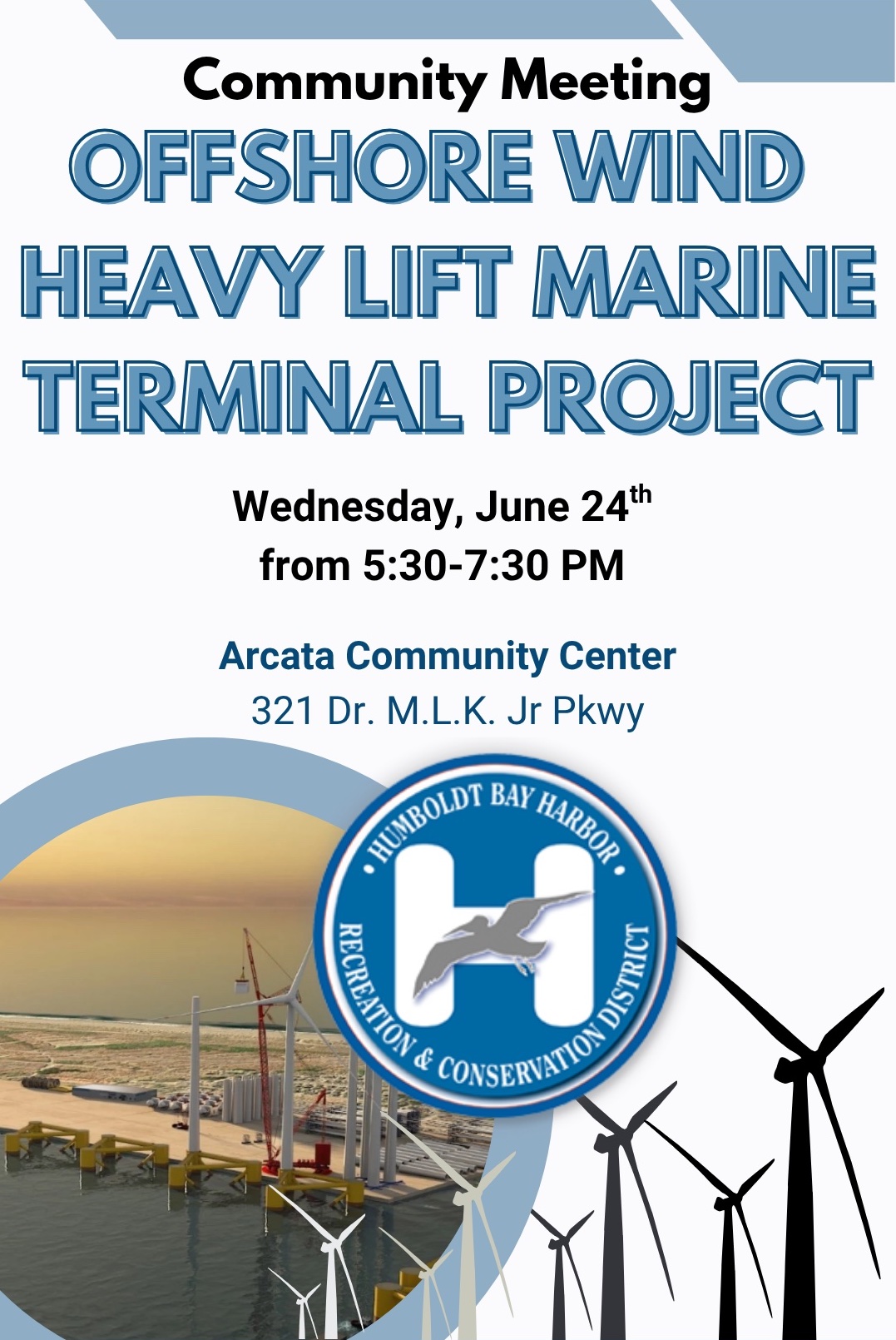 The Humboldt Bay Harbor District's Community Advisory Committee for the Offshore Wind Heavy Lift Marine Terminal Project is hosting a public meeting with technical speakers, a panel of experts, and multiple stations at which participants can talk to engineers and environmental scientists that are designing/permitting the project. It will be a good opportunity to learn more about what is being proposed, and to think about the impacts that should be analyzed, how those impacts can best be minimized or mitigated, and project alternatives that could lessen these impacts. When: Wednesday, June 24, 5:30-7:30 pm