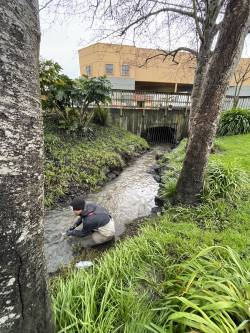
In 2020, 6PPD-quinone, the breakdown product of the tire preservative 6PPD, was identified as a major contributor to Urban Runoff Mortality Syndrome in the Puget Sound watershed, where adult Coho Salmon often die before spawning in areas with high concentrations of road runoff. Since then, studies have been done in San Francisco Bay, but little information is available beyond major metropolitan areas. This study is the first to examine concentrations of 6PPD-q in Humboldt County. Left: Alex Juan sampling Jolly Giant Creek in Arcata for 6PPD-quinone. Photo by Audrey Jackson, Wiyot Tribe Shawir Darrudaluduk. Juvenile Coho, which are extremely sensitive to this toxic chemical, rely on small tributaries to Wigi (now known as Humboldt Bay in English) for overwintering habitat. Some of these small streams – particularly the reaches closest to Humboldt Bay – are within urban areas dominated by impervious surfaces, including parking lots and roads.The goal of the project was to determine whether 6PPD-q is present in the region in concentrations that could be harmful to Coho Salmon and other aquatic species. Between October 2024 and May 2025, the Wiyot Tribe Shawir Darrudaluduk (Natural Resources Department) and Humboldt Waterkeeper sampled seven small urban streams and four large parking lots that discharge stormwater runoff into Humboldt Bay, the Wiya’t (now known as the Eel River) near Fortuna, or the Baduwa’t (now known as the Mad River) near Blue Lake. Sixty-three percent of samples (12 out of 19) exceeded the U.S. EPA aquatic screening level for 6PPD-q of 11 nanograms per liter (ng/L). Eight of the nine samples collected in Jolly Giant Creek in Goudi’ni (now known as Arcata) exceeded the screening level. The highest concentrations were found in parking lot runoff. All four parking lot samples contained 6PPD-q concentrations well above the LC50 for juvenile Coho Salmon.Potential solutions include developing 6PPD substitutes, infrastructure improvements like enhanced street sweeping, capture and treatment of stormwater (e.g., bioswales), consistent road maintenance to reduce wear and tear on tires, and individual actions to reduce tire wear (e.g., proper inflation, careful driving, alternative transportation). Addressing local sampling gaps and implementing effective solutions will require coordinated funding and multi-agency efforts across the region.Keep Reading (PDF)
 In 2020, 6PPD-quinone, the breakdown product of the tire preservative 6PPD, was identified as a major contributor to Urban Runoff Mortality Syndrome in the Puget Sound watershed, where adult Coho Salmon often die before spawning in areas with high concentrations of road runoff. Since then, studies have been done in San Francisco Bay, but little information is available beyond major metropolitan areas. This study is the first to examine concentrations of 6PPD-q in Humboldt County. Left: Alex Juan sampling Jolly Giant Creek in Arcata for 6PPD-quinone. Photo by Audrey Jackson, Wiyot Tribe Shawir Darrudaluduk. Juvenile Coho, which are extremely sensitive to this toxic chemical, rely on small tributaries to Wigi (now known as Humboldt Bay in English) for overwintering habitat. Some of these small streams – particularly the reaches closest to Humboldt Bay – are within urban areas dominated by impervious surfaces, including parking lots and roads.The goal of the project was to determine whether 6PPD-q is present in the region in concentrations that could be harmful to Coho Salmon and other aquatic species. Between October 2024 and May 2025, the Wiyot Tribe Shawir Darrudaluduk (Natural Resources Department) and Humboldt Waterkeeper sampled seven small urban streams and four large parking lots that discharge stormwater runoff into Humboldt Bay, the Wiya’t (now known as the Eel River) near Fortuna, or the Baduwa’t (now known as the Mad River) near Blue Lake. Sixty-three percent of samples (12 out of 19) exceeded the U.S. EPA aquatic screening level for 6PPD-q of 11 nanograms per liter (ng/L). Eight of the nine samples collected in Jolly Giant Creek in Goudi’ni (now known as Arcata) exceeded the screening level. The highest concentrations were found in parking lot runoff. All four parking lot samples contained 6PPD-q concentrations well above the LC50 for juvenile Coho Salmon.Potential solutions include developing 6PPD substitutes, infrastructure improvements like enhanced street sweeping, capture and treatment of stormwater (e.g., bioswales), consistent road maintenance to reduce wear and tear on tires, and individual actions to reduce tire wear (e.g., proper inflation, careful driving, alternative transportation). Addressing local sampling gaps and implementing effective solutions will require coordinated funding and multi-agency efforts across the region.Keep Reading (PDF)