Humboldt Waterkeeper
  • About Us
    • Our Mission
    • Waterkeeper Alliance
  • Humboldt Bay
    • Geography
    • Wildlife
    • Bay Issues
    • Photo Gallery
  • Programs
    • Toxics Initiative
    • Water Quality
    • Bay Tours
    • Community Outreach
  • Get Involved
    • Report Pollution
    • Speak Out
    • Volunteer
    • Donate
    • Membership
    • Stay Informed
  • Contact Us
  • News
    • Latest
    • Press

News

A Whale of a Recovery for California’s Blue Whales

Details
Andrew C. Revkin, New York Times
Latest
Created: 10 September 2014

9/5/14

The blue whale, the biggest animal on the planet, was hunted with abandon in the Pacific Ocean until the early 1970s. The species has been rebounding ever since, but a slowdown in the growth of the population frequenting waters off the California coast was a concern. Now it turns out to be a promising sign of recovery.


Scientists at the University of Washington have just published research finding that the West Coast blue whale population of around 2,200 individuals appears to be approaching its pre-slaughter size, with the slowing growth a function of the carrying capacity of the marine ecosystem. Collisions with ships remain a problem, the scientists write, but should not affect the whales’ prospects.


The paper — ”Do ship strikes threaten the recovery of endangered eastern North Pacific blue whales?” — was posted online today by the journal Marine Mammal Science. Here’s the core of the abstract:


We used a population dynamics model to assess the trends and status of ENP [eastern North Pacific] blue whales, and the effects of ship strikes. We estimate the population likely never dropped below 460 individuals, and is at 97% of carrying capacity (95% interval 62%–99%). These results suggest density dependence, not ship strikes, is the key reason for the observed lack of increase. We also estimate future strikes will likely have a minimal impact; for example, an 11-fold increase in vessels would lead to a 50% chance the long-term population would be considered depleted. Although we estimate ship strike mitigation would have minimal impacts on population trends and status, current levels of ship strikes are likely above legal limits set by the U.S. The recovery of ENP blue whales from whaling demonstrates the ability of blue whale populations to rebuild under careful management.


As the university news release noted, it’s important to keep in mind that the California recovery is a tiny bright spot given that researchers estimate (from other work) that the 3,400 whales killed in that population from 1905 to 1971 pale beside the 346,000 harpooned in Antarctic waters in the same span.


The National Oceanic and Atmospheric Administration estimates that the Southern Hemisphere population was 175,000 before the whaling binge and is about 2,000 today.


One of the paper authors, the doctoral candidate Cole Monnahan, has a fascinating piece on the North Pacific whale research on a great new blog he maintains with another author, Trevor Branch, called Blue Whale News. In the post, Monnahan stresses the big questions that remain about the more heavily hunted blue whale populations in the western North Pacific. Here’s the kicker:


So what do we know about the population structure in other areas? In the western North Pacific, we know there is at least one population that spends a significant portion of their time, including the mating season, too far west for our hydrophones to hear them. The truth is no one knows what populations exist (or existed) in the western North Pacific. Thousands of whales were caught off Japan early in the 1900s, but none have been seen since. Was that a population that was killed off forever? Where do the blue whales go during the winter months to breed? These are exciting questions for future researchers to tackle.


To get a sense of the mix of whaling-era data, tracking and modeling used to estimate past blue whale abundance, read this PloS ONE paper by an overlapping research team from last year: “Estimating Historical Eastern North Pacific Blue Whale Catches Using Spatial Calling Patterns.”

 

Read Original Article

‘CAPPY’ TRAILS Scenic loop renamed for environmentalist who helped develop area

Details
Shaun Walker, Times Standard
Latest
Created: 05 September 2014

A small crowd walks a scenic loop — which was renamed and dedicated to Melvin “Cappy” McKinney on Thursday — along the Hikshari Trail in Eureka. McKinney, who passed away in June of last year, worked for 10 years to help get the trail developed along the Elk River estuary. Friends said he was an ardent environmentalist who fished there and patrolled the area.


County closes escrow on McKay Tract 

Management plan

Details
Will Houston, Times-Standard
Latest
Created: 01 September 2014

Trail access points to be shaped in coming months


9/1/14


After nearly four years of work between state, timber and local officials, Humboldt County has the title to nearly 1,000 acres of community forest southeast of Eureka after closing escrow with Green Diamond Resource Com­pany.


“Having it actually close es­crow, that means this is the com­munity’s forest now,” 3rd District Supervisor Mark Lovelace said. “It’s not the county of Humboldt that owns it, it’s the people of the county of Humboldt that own it. As a community forest, the man­agement and the trail planning will be guided by public input.”


The county was able to pur­chase a portion of Green Diamond Resource Company’s 7,600-acre McKay Tract using $6.8 million in funds received from three state agencies: the Wildlife Conserva­tion Board, the California Natural Resources Agency and the Cali­fornia State Coastal Conservancy.


Having received the full fund­ing in May, Public Works Depart­ment Deputy Director Hank See­mann said closing escrow with Green Diamond on Aug. 21 was a hurdle that required several months to jump. 


“There is a lot going into closing escrow,” Seemann said. “That was a big accomplishment.”


Next Monday, Seemann said, the county will make a formal announcement on the purchase and future plans at a ribbon-cutting ceremony.


Proposed to generate revenue for the county through sustainable timber harvesting practices while providing outdoor community access and educational opportunities, the McKay Tract Community Forest has been an eagerly awaited addition for the county.


As the land has only hosted timber harvesting owners for several generations, Seemann said the current infrastructure and trail system needs improvement to make the county’s vision come to fruition.


“We want to the public to see this new public land, but we need to get it ready first,” Seemann said. “We do have a goal of trying to set up a good access point and at least a short trail loop as soon as possible. It’s hard to pinpoint a month. With a project of this magnitude, things need to come together before we open it up.”


As part of the county’s agreement with the funding state agencies, the county must develop a management plan to lay out how it will balance the forest’s intended uses. A state environmental review will also have to be performed before any projects can move forward. On the forefront of this effort is designing access points to the forest and developing a trail system.


“That’s going to take some time because there are really important issues such as being compatible with adjacent properties and having access trail points that avoid user conflicts,” Seemann said. “The community forest will be used by people who are walking, running, equestrians, riding bikes. So it’s really important that different speeds, different sizes, different capabilities are accounted for. And, they have to be tied to appropriate access points.”


While the property has existing roads and trails made by trespassers over the years, Seemann said more trails will have to be built or altered so that users are no longer trespassing on private land. Another issue that has to be addressed is parking.


“There are no perfect, ready-to-go access points,” Seemann said. “We have some top candidates, but they all need work before they can be opened up.”


There will be no lack of volunteer help to build and maintain the trails as the Humboldt Volunteer Trail Stewards have been recruiting for the project since last year.


“They already have over 100 people signed up who want to do work in this forest,” Lovelace said. “I’ve been out there on trail days where there has been 50 volunteers and seen them cut 600 feet of new trail from nothing. ... It’s pretty phenomenal what a group of volunteers can accomplish in four hours.”


Rees Hughes, one of the trail coordinators, said the group began outreach efforts last year in order to show how supportive the community would be should the board vote to purchase the land. Now that the focus has shifted from purchasing the forest to preparing it for public use, Hughes said he, his fellow volunteers and the county all have their work cut out for them.


“Based on what I see, it will take a while,” he said. “This has been a parcel of land that has been used for industrial timber for many generations. It will probably take longer than we all want to get it ready for general public use.”


More information on volunteering to build and maintain McKay Tract trails can be found at www.humtrails.org/mckay.html.


Read Original Article

Melvin “Cappy” McKinney is honored with a local memorial trail

Details
Chris Butner, Complete Streets Advocate
Latest
Created: 11 August 2014

At the August 5th Eureka City Council meeting, council unanimously voted to approve this request, to make it official. See the council video clip of this agenda item here.


A few life facts about Melvin -

  • born September 27th, 1933 in Mountain Lake, MN 
  • passed away June 7th, 2013 in Eureka, CA
  • served in the US Navy
  • worked as an electrical worker for many years, and proud union member

After retiring Melvin was a passionate environmental advocate in the Eureka/Humboldt Bay region. His primary passion was the Elk River area, which was the driving force to honor this trail in his name.  Melvin was a strong advocate behind the Elk River wildlife area , being upgraded to a sanctuary in 2003.  Melvin was very active in speaking at Eureka City Council meetings, educating citizens and government entities alike.

At the Aug 5th council meeting, many citizens and environmental groups spoke publicly in favor to approve this request.  One example of this was Larry Glass, President of the Northcoast Environmental Center – sharing support on behalf of the NEC for this request. Larry said “I miss Mel, he was a good friend of mine, great guy, and worked tirelessly to protect this area”.  In Aug of 2013, after Mel’s passing the NEC contributed an article to highlight the wonderful legacy of Mel on the North Coast.


Where is the memorial trail located?

The Melvin “Cappy” McKinney Memorial loop trail in located mid-way on the Hikshari trail in Eureka, CA.  You can find more general info about the Hikshari trail on TrailLink.com, which includes a map, access points, etc.  The Hikshari trail is paved, and the Melvin Mckinney trail is a gravel surface.  The memorial trail is a semi loop with two access points along the Hikshari trail.  A beautiful segment of trail that is a wonderful place to reflect on Mel as you move about the Elk River area.  Parking is an option for both automobiles, and secure bicycle parking at the mid-way right by the memorial trail.  As seen in the TrailLink map, the dotted line on the map highlights the memorial loop.


Read More

Humboldt County Issues Blue-Green Algae Warning

Details
HBK
Latest
Created: 27 July 2014


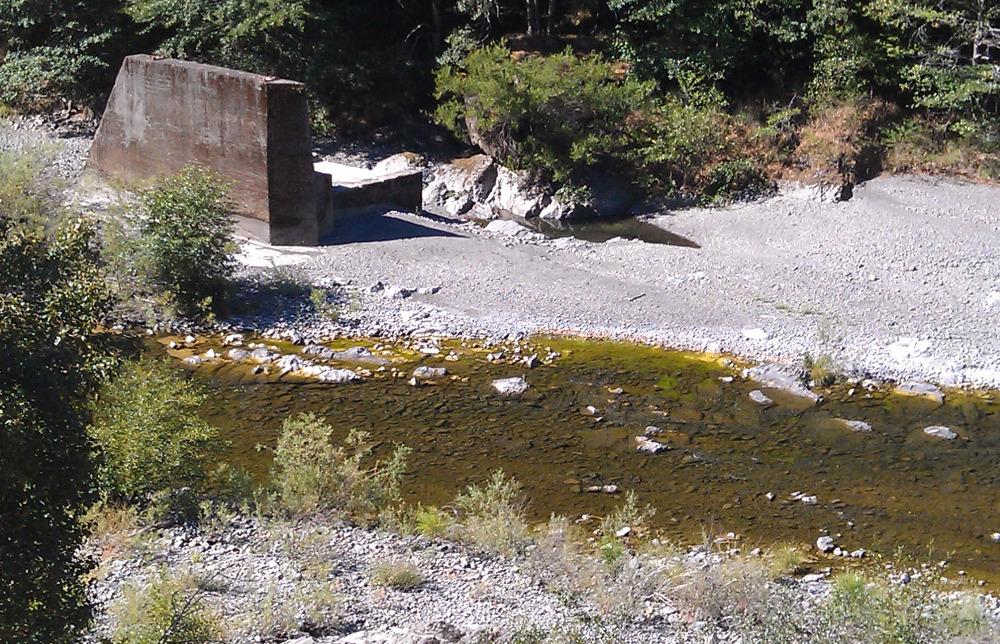
Officials with the Humboldt County Department of Health and Human Services (DHHS) are warning recreational users of all fresh water bodies to avoid contact with algae this summer and early fall.


Blue-green algae, also known as cyanobacteria, are found naturally in water and wet environments, but prefer warm, stagnant, nutrient-rich water and are found most often in ponds, lakes, and slow moving rivers.

Photo: Algae in the South Fork Eel River, 7/17/14

Read more …

More Articles …

  1. The 'Golden Rule' will sail again
  2. Samoa pulp mill cleanup delayed
  3. Budget bill gives Coastal Commission power to impose fines
  4. Sea star wasting syndrome epidemic along the coast

Latest

Press

Page 110 of 200
  • Start
  • Prev
  • 105
  • 106
  • 107
  • 108
  • 109
  • 110
  • 111
  • 112
  • 113
  • 114
  • Next
  • End

Advanced Search

Current Projects

  • Mercury in Local Fish & Shellfish
  • Nordic Aquafarms
  • Offshore Wind Energy
  • Sea Level Rise
  • 101 Corridor
  • Billboards on the Bay
  • Dredging
  • Advocacy in Action
  • Our Supporters
Report A Spill
California Coastkeeper
Waterkeeper Alliance
Copyright © 2026 Humboldt Waterkeeper. All Rights Reserved.