Humboldt County's new Outdoor Lighting Ordinance has many people asking, “How can I protect the night sky?”To protect the night sky, choose lighting that is fully shielded, directed downward, and turns off when not needed. Brightness is 1,000 lumens or less, and the color temperature is warm (2,700 K or less).For info on addingshielding to existing fixtures, buying fully-shielded fixtures, and more, check out our new flier: How to Protect the Night Sky & Prevent Light Pollution! Why is it important to protect the night sky from light pollution?Light pollution can disrupt the circadian rhythms of people, wildlife, and migrating birds. It is especially harmful to migratory birds and wildlife (PDF). Migratory birds travel at night so they can use the stars for navigation, avoid predators, fly in calmer air, avoid overheating and to refuel during the day. These birds are especially vulnerable to light pollution as it can cause birds to collide with lit structures, start migration early or late, disrupt sleep cycles, and modify the timing of life cycles. Some examples of local night-migrating birds include the Snowy Plover, Marbled Godwit, Rufous Hummingbird, Varied Thrush, and Wilson’s Warbler.Studies have found that frequent exposure to artificial light disrupts people’s circadian rhythms, which can contribute to insomnia, depression, obesity, and inflammation. Sleep studies have found that the level and duration of darkness we experience before sleep is more important than the amount of time spent in bed. Melatonin, the hormone that helps you sleep, can be suppressed by exposure to blue light. Artificial light at night has been found to contribute to certain cancers, heart disease, and diabetes.Even plants can be impacted by light pollution, which can alter growth, timing of flowering, and resource allocation. This can have a cascading effect on the migratory patterns of pollinators and seed-dispersers that rely on nectar, pollen, seeds, and fruits for food.Dark Sky Light FixturesDarkSky International is a non-profit organization leading the campaign to reduce light pollution and globally make our skies darker. For a light fixture to become DarkSky Approved, it must restrict the amount of upward-directed light, avoid glare, avoid over-lighting, utilize dimming and other appropriate lighting controls, and minimize short-wavelength (blue-ish) light in the nighttime environment. To explore Dark Sky’s list of approved light fixtures, visit their DarkSky Approved products page.Humboldt County Outdoor Lighting Ordinance is based on Dark Sky International’s 5 Principles of Responsible Lighting:
Use light only if it is needed. All light should have a clear purpose. Consider how the use of light will impact the area, including wildlife and their habitats.
Direct light so it falls only where it is needed. Use shielding and careful aiming to target the direction of the light beam so that it points downward and does not spill beyond where it is needed.
Light should be no brighter than necessary. Use the lowest light level required. Be mindful of surface conditions, as some surfaces may reflect more light into the night sky than intended.
Use light only when it is needed. Use controls such as timers or motion detectors to ensure that light is available when it is needed, dimmed when possible, and turned off when not needed.
Use warmer color lights where possible. Limit the amount of shorter wavelength (blue-violet) light to the least amount needed.
When, where, and how does the new ordinance apply?The County’s new Inland lighting ordinance applies to unincorporated areas outside of the Coastal Zone. The Coastal lighting ordinance will go into effect after it is approved by the Coastal Commission.The new ordinance applies to new development. Outdoor lighting that predates the adoption of the ordinance, and aligns with zoning regulations when it was installed, may remain unless the County receives a nuisance complaint or there are substantial changes to the property (including expansion).The ordinance requires the following: all outdoor lighting fixtures must be fully shielded (see examples below), be directed downward and away from neighboring properties, the public right-of-way, wildlife habitat or the sky. Outdoor lights must only be on when the area to be lit is actively being used, or for safety purposes, and are limited to the property engaged in a permitted activity. Additionally, residential outdoor lighting must be no brighter than 1,100 lumens and commercial/industrial/agricultural outdoor lighting must be no brighter than 3,200 lumens.The following types of lighting are prohibited: aerial lasers, search-light style lights, mercury vapor lights, flashing lights, low-pressure sodium fixtures, and any lighting that creates glare or distraction to the traveling public. A Conditional Use Permit may be sought to use these types of lights for a special event, provided the lights are necessary for the event, and light will not spill onto neighboring properties.The following are exempt as long as they don’t cause light trespass onto adjacent properties, the night sky, or wildlife habitat: temporary holiday decorations; flag-illuminating lights; string lights with a Correlated Color Temperature (CCT) of 2700 Kelvins (K) or less (and they must be turned off by 10 pm); emergency lighting; and motion detector lighting fixtures (limited to 5 minutes and cannot be triggered from beyond the property line).On August 19, 2025 the Board of Supervisors approved the Inland Lighting ordinance, which was recently incorporated into the County Municipal Code, Section 314-105. Conditional Use Permits will be required to light newly-constructed outdoor athletic fields. Street lights will be covered in a Street light Ordinance, along with new language about lighting in parking lots. We hope these ordinances will be brought to the Planning Commission by the end of 2025.To stay informed of opportunities for comment, you can send an email to This email address is being protected from spambots. You need JavaScript enabled to view it. and we’ll add you to our list.

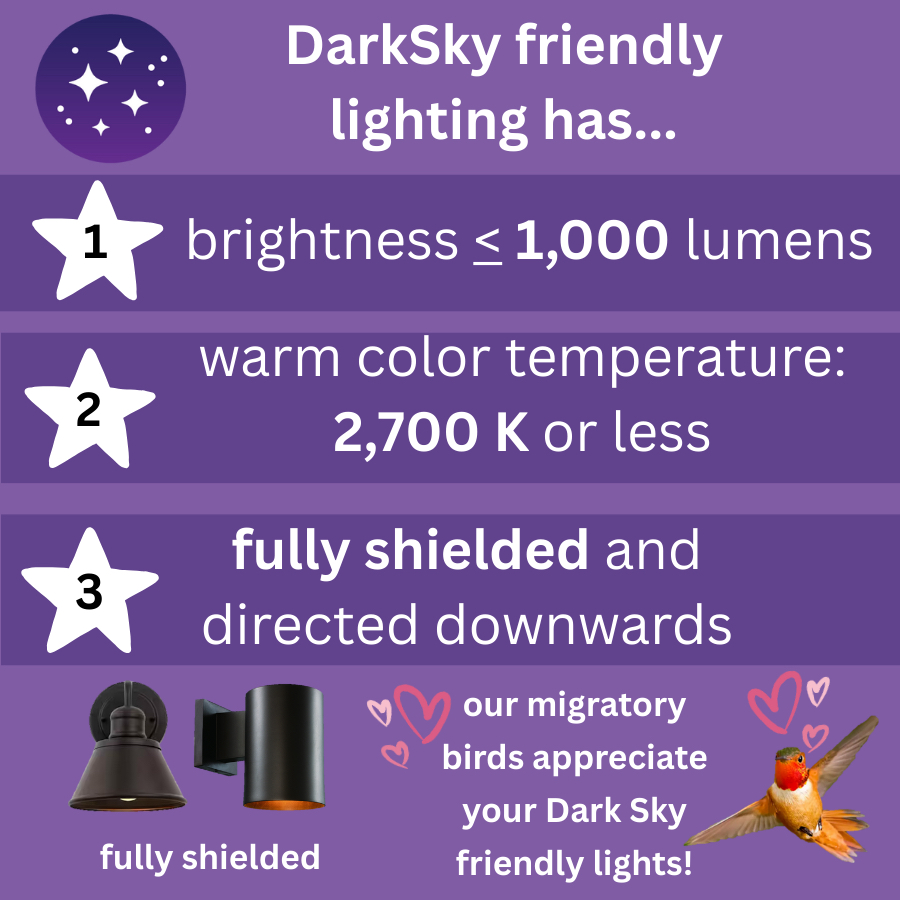 Humboldt County's new Outdoor Lighting Ordinance has many people asking, “How can I protect the night sky?”To protect the night sky, choose lighting that is fully shielded, directed downward, and turns off when not needed. Brightness is 1,000 lumens or less, and the color temperature is warm (2,700 K or less).For info on adding shielding to existing fixtures, buying fully-shielded fixtures, and more, check out our new flier: How to Protect the Night Sky & Prevent Light Pollution! Why is it important to protect the night sky from light pollution?Light pollution can disrupt the circadian rhythms of people, wildlife, and migrating birds. It is especially harmful to migratory birds and wildlife (PDF). Migratory birds travel at night so they can use the stars for navigation, avoid predators, fly in calmer air, avoid overheating and to refuel during the day. These birds are especially vulnerable to light pollution as it can cause birds to collide with lit structures, start migration early or late, disrupt sleep cycles, and modify the timing of life cycles. Some examples of local night-migrating birds include the Snowy Plover, Marbled Godwit, Rufous Hummingbird, Varied Thrush, and Wilson’s Warbler.Studies have found that frequent exposure to artificial light disrupts people’s circadian rhythms, which can contribute to insomnia, depression, obesity, and inflammation. Sleep studies have found that the level and duration of darkness we experience before sleep is more important than the amount of time spent in bed. Melatonin, the hormone that helps you sleep, can be suppressed by exposure to blue light. Artificial light at night has been found to contribute to certain cancers, heart disease, and diabetes.Even plants can be impacted by light pollution, which can alter growth, timing of flowering, and resource allocation. This can have a cascading effect on the migratory patterns of pollinators and seed-dispersers that rely on nectar, pollen, seeds, and fruits for food.Dark Sky Light FixturesDarkSky International is a non-profit organization leading the campaign to reduce light pollution and globally make our skies darker. For a light fixture to become DarkSky Approved, it must restrict the amount of upward-directed light, avoid glare, avoid over-lighting, utilize dimming and other appropriate lighting controls, and minimize short-wavelength (blue-ish) light in the nighttime environment. To explore Dark Sky’s list of approved light fixtures, visit their DarkSky Approved products page.Humboldt County Outdoor Lighting Ordinance is based on Dark Sky International’s 5 Principles of Responsible Lighting: